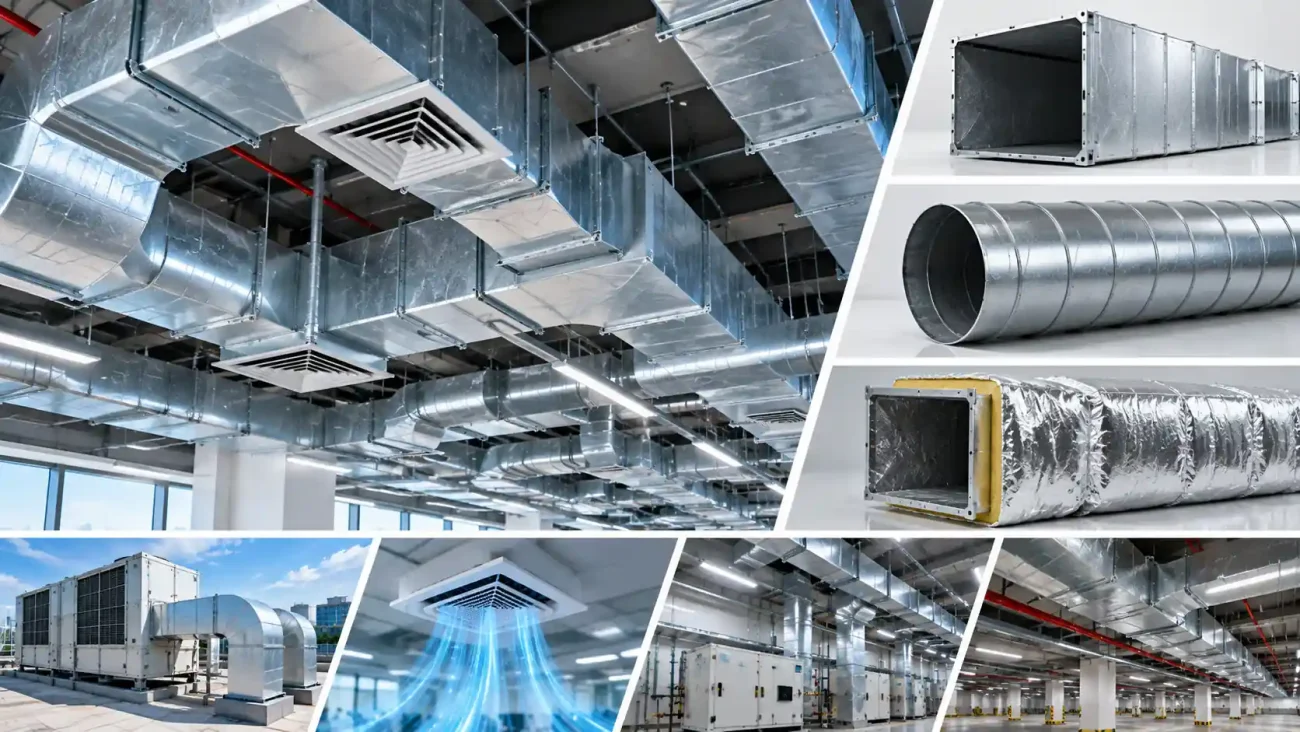
What Is a Chiller System? Types, Working Principle and Applications

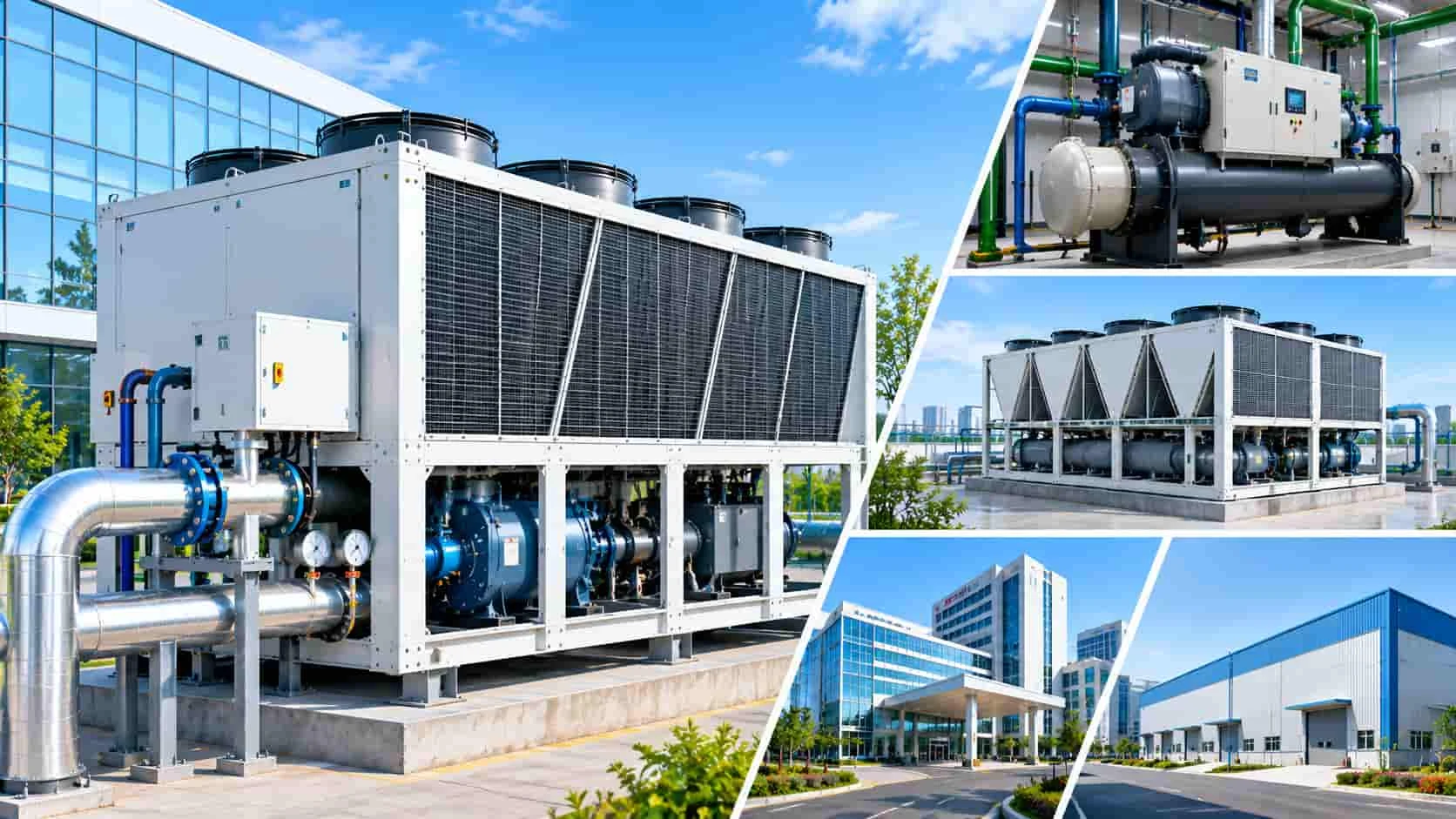
What is a chiller system? A chiller system is a central cooling plant that removes heat from water or another liquid and circulates the chilled liquid through a building or process. Instead of cooling air room by room, it cools water at one point. Air handling units (AHUs) and fan coil units (FCUs) then use that cold water to cool the air.
This is why chiller systems are the standard choice for hotels, hospitals, malls, offices and factories across India. In this guide, Healthy Aircool Pvt. Ltd. (HAPL), an ISO-certified HVAC and MEP contractor in Ghaziabad, explains how chillers work, the main types, and where each one fits.
What Is a Chiller System in HVAC?
In HVAC, a chiller system is the heart of a “chilled water” cooling setup. The chiller itself chills the water. The rest of the system carries that water to where cooling is needed and rejects the collected heat outdoors.
Chillers are designed for large and continuous cooling loads. Split ACs and VRF systems cool the air directly with refrigerant, but a chiller plant suits buildings that need high capacity, long running hours and centralized control.
Main Components of a Chiller System
A complete chiller plant includes more than the chiller unit:
- Compressor: raises the pressure and temperature of the refrigerant.
- Evaporator: transfers heat from the returning water to the refrigerant.
- Condenser: releases the absorbed heat to air or water.
- Expansion device: drops refrigerant pressure before it re-enters the evaporator.
- Chilled water pumps and piping: carry cold water to AHUs and FCUs.
- Cooling tower and condenser water pumps: needed in water-cooled systems.
- Control panel and sensors: manage capacity, safety and efficiency.
Working Principle of a Chiller System
Most chillers use the vapour-compression refrigeration cycle. The process runs in a continuous loop:
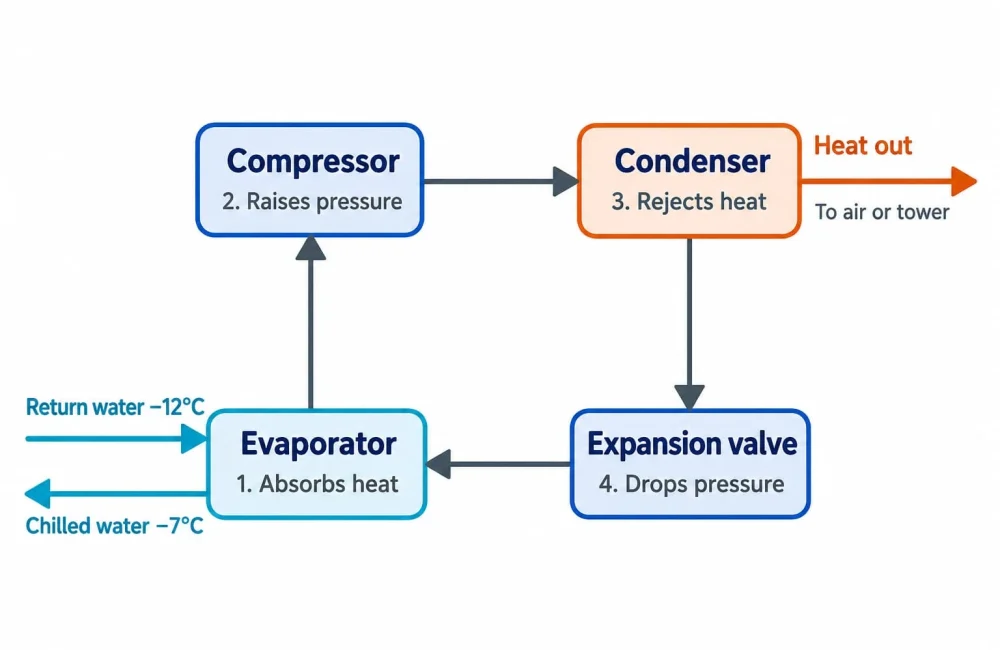
The vapour-compression cycle in a chiller. Water temperatures are typical values; your consultant’s design sets the exact figures.
-
Evaporation:
Warm return water, commonly around 12°C, passes through the evaporator. The refrigerant absorbs its heat and evaporates, cooling the water to roughly 7°C. -
Compression:
The compressor squeezes the refrigerant vapour, raising its pressure and temperature. -
Condensation:
In the condenser, the hot refrigerant gives up its heat to outdoor air or to condenser water, and turns back into liquid. -
Expansion:
The expansion valve lowers the pressure, which cools the refrigerant so it can absorb heat again. -
Distribution:
Pumps send the chilled water to AHUs and FCUs, where air passes over cold coils and is delivered into the space.
Types of Chiller Systems
Chillers are classified by how they reject heat and by the type of compressor they use.
Air-cooled chillers
Fans push outdoor air over the condenser coils. They need no cooling tower, so installation is simpler and water use is lower. They suit small and mid-size projects, rooftops and sites with limited water. Efficiency is usually lower than water-cooled units, especially in peak summer heat.
Water-cooled chillers
Heat goes to condenser water, which then flows to a cooling tower. They are generally more energy-efficient and preferred for large, long-running loads such as hospitals, malls and office towers. They need more space, water treatment and tower maintenance.
Types by compressor
- Scroll chillers: compact and quiet, suited to smaller capacities.
- Reciprocating chillers: an older design, now less common in new projects.
- Screw chillers: reliable mid-to-large capacity units with good part-load behaviour.
- Centrifugal chillers: built for the largest loads, and widely used in big commercial plants and campuses.
Vapour absorption chillers
Absorption chillers use a heat source such as steam, hot water or gas instead of a mechanical compressor, typically with a lithium bromide–water pair. They make sense where waste heat is available or electricity supply is a constraint.
Applications of Chiller Systems
Once you understand what is a chiller system, its value in demanding buildings becomes clear. Common applications include:
- Hotels: 24/7 guest comfort across many rooms and public areas.
- Hospitals: stable temperature control where system failure is not acceptable.
- Corporate offices: efficient cooling for continuously occupied towers.
- Shopping malls: high footfall and long operating hours.
- Industrial and pharma facilities: process cooling and controlled environments.
- Data centres, telecom and food processing: precise, round-the-clock cooling.
Benefits of a Chiller System
- Centralized control: one plant serves the whole building.
- High capacity: handles large and variable loads reliably.
- Energy efficiency: modern chillers perform well at part load, which is where buildings spend most of their time.
- Scalability: capacity can be staged by adding units.
- Longer service life: well-maintained plants run for many years.
How to Choose the Right Chiller System
The right choice depends on the project, and the final selection is normally set by the consultant’s design. These are the factors that decide it:
- Total cooling load and how it varies through the day
- Space available for the plant room, rooftop and cooling tower
- Water availability and quality
- Power supply and energy cost
- Operating hours and redundancy needs
- Lifecycle cost, not just purchase price
For energy-efficiency benchmarks and standards, you can refer to ASHRAE and the Bureau of Energy Efficiency.
Chiller Maintenance: Why It Matters
A chiller that is not maintained loses efficiency and risks breakdown in peak season. Good upkeep includes regular tube cleaning, refrigerant and oil checks, water treatment, pump and valve inspection, and control calibration. A structured AMC (CAMC) plan keeps performance steady, cuts energy waste and prevents emergency shutdowns.
Chiller System Installation by HAPL
HAPL executes chiller system installation for commercial and industrial projects across India, including testing and commissioning. We work to designs provided by your consultant or architect, and our team can continue with chiller maintenance after handover. This sits alongside our wider HVAC services, AHU services and ducting solutions.
Planning a project? Read our guide on how to choose an HVAC contractor in India, then contact HAPL for a site assessment.
Frequently Asked Questions
1. What is a chiller system used for?
A chiller system cools water that is piped through a building or process to absorb heat. It is used for air conditioning in large buildings and for process cooling in industry.
2. What are the main types of chillers?
The main types are air-cooled and water-cooled chillers. By compressor, they are scroll, reciprocating, screw and centrifugal. Vapour absorption chillers are a separate heat-driven type.
3. What is the difference between a chiller and an AC?
An AC cools air directly using refrigerant. A chiller cools water, which then cools air through AHUs or FCUs, making it better for large, centralized systems.
4. Which is better, air-cooled or water-cooled?
Water-cooled is generally more efficient for large loads. Air-cooled is simpler and suits smaller sites or places with limited water.
5. How long does a chiller last?
With regular maintenance, chillers commonly run for 15 to 25 years, depending on type, operating hours and care.
Conclusion
So, what is a chiller system? It is a centralized cooling plant that chills water and delivers reliable, efficient cooling to large buildings and industrial processes. Choosing the right type and keeping it well maintained protects both comfort and operating cost. HAPL can support you with chiller installation, commissioning and AMC.
Need a chiller plant installed or maintained?
Talk to HAPL’s engineering team about chiller installation, commissioning and AMC for your hotel, hospital, office or industrial site.
Call +91-120-2988666 or WhatsApp +91 98100 67867